🌍 What is the middle-income trap? Discover why nations struggle to transition to advanced prosperity, learn from success stories like South Korea, and explore actionable solutions. Dive into economic theories, real-world examples, and expert insights. 💡
The Middle-Income Trap: Why Progress Stalls (And How Some Nations Break Free)
🌐 Picture climbing a ladder. Reaching the middle rungs feels manageable, but the final steps to the top? Exhausting and elusive. This mirrors the middle-income trap—a global phenomenon where countries grow from poverty to moderate wealth but stall before achieving advanced prosperity. Let’s unpack why this happens, which nations have escaped, and what strategies work.
📊 Understanding the Middle-Income Trap
The middle-income trap occurs when economies succeed initially through low-wage manufacturing or resource exports but fail to transition into innovation-driven, high-income societies. Think of it like mastering a skill:
- Basics to intermediate? Achievable with practice.
- Intermediate to expert? Demands creativity, adaptability, and grit.
Countries like Mexico or Indonesia often grow rapidly by leveraging cheap labor or natural resources. However, advancing further requires advanced technology, skilled workforces, and robust institutions—hurdles many struggle to overcome.
🌟 Success Stories: Nations That Escaped the Trap
The World Bank identified 13 countries that escaped the trap by 2008. South Korea’s transformation is legendary:
- 1960s–1980s: Focused on textiles and electronics assembly.
- 1990s–Today: Became a tech powerhouse (Samsung, Hyundai) and cultural exporter (K-pop).
Singapore and Ireland also thrived by prioritizing education, foreign investment, and innovation hubs. In contrast, nations like Brazil and South Africa remain stuck due to political instability and inequality.
📈 Middle-Income Nations: Key Statistics
- 75% of the global population lives in middle-income countries.
- 40% of world GDP comes from these economies.
- 66% of extreme poverty is concentrated here.
According to the World Bank (2023), middle-income countries have a per capita GNI of $1,136–$13,845. Examples include India, Thailand, and Colombia.
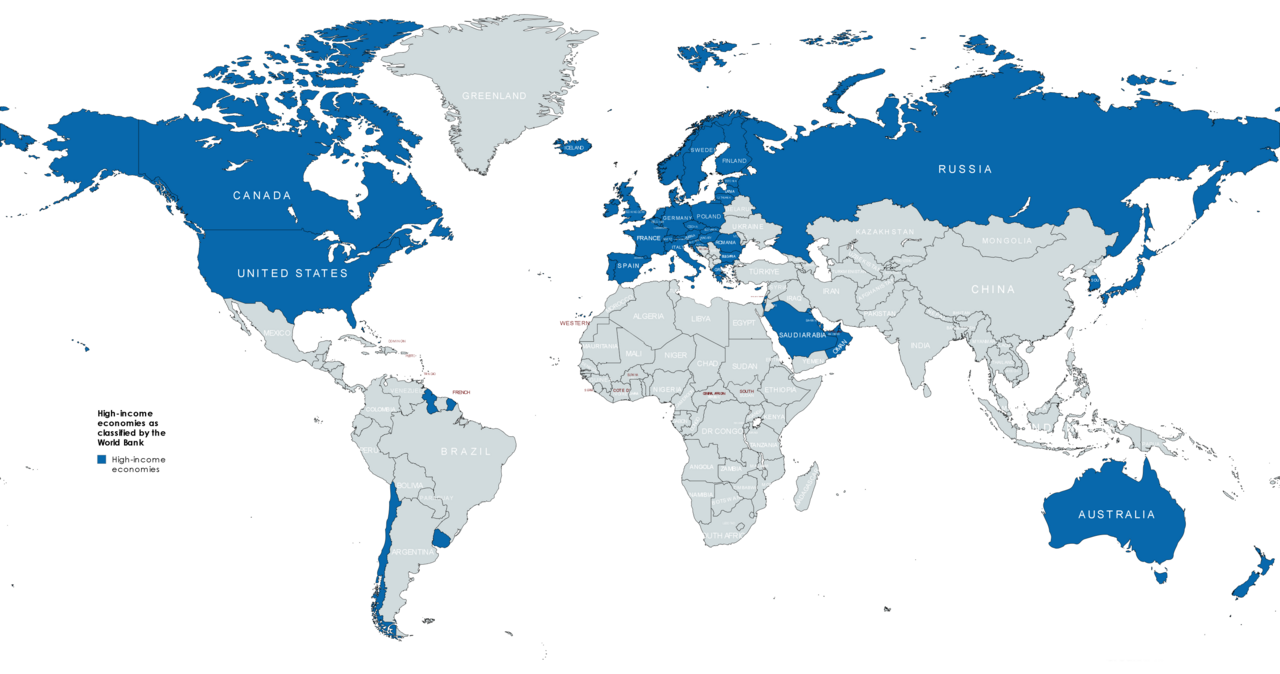
Map showing high-income economies (blue) as classified by the World Bank in 2023. Source: Wikimedia Commons, CC BY-SA 4.0

🏗️ Rostow’s Economic Growth Model: Where Do Countries Falter?
Economist Walt Rostow’s 5-stage development model outlines how nations evolve:
- Traditional Society: Reliant on agriculture; limited technology.
- Preconditions for Take-Off: Infrastructure and education investments begin.
- Take-Off: Rapid industrialization (e.g., China’s 1990s manufacturing boom).
- Drive to Maturity: Tech innovation and economic diversification.
- High Mass Consumption: Service-based, high-income economy.
Most countries stumble between Stage 3 and 4. Why?
🔍 4 Reasons Nations Get Trapped
1. Innovation Shortfalls 🧪
Relying on foreign technology or cheap labor works temporarily, but stagnation follows without homegrown R&D. Example: Malaysia’s electronics sector boomed in the 2000s but lagged behind South Korea due to weaker innovation systems.
2. Weak Institutions 🏛️
Corruption, bureaucracy, and unstable policies deter investment. Brazil’s “Custo Brasil” (high operational costs) hampers growth despite its vast resources.
3. Education Gaps 🎓
Without skilled workers, industries can’t upgrade. Thailand’s education system ranks 89th globally (World Economic Forum), slowing tech adoption.
4. Premature Wage Growth 💸
Rising wages (e.g., China’s 10% annual increases) push companies to cheaper markets like Vietnam, causing industrial decline.
🛠️ How to Escape: Lessons from South Korea, Singapore & More
✅ Boost Innovation
South Korea invests 3.7% of GDP in R&D (vs. 1% in Argentina). Tax breaks for startups and patent protections fuel high-value sectors like semiconductors.
✅ Strengthen Governance
Singapore’s Corrupt Practices Investigation Bureau (CPIB) reduced graft, attracting global investors.
✅ Upgrade Education
Finland’s teacher-training model lifted its global education rankings; Vietnam replicated this to nurture STEM talent.
✅ Diversify the Economy
Dubai shifted from oil to tourism and finance, which now contribute 70% of its GDP.
🌐 The Future: Challenges & Opportunities
Middle-income nations face a demographic dilemma: young populations need jobs, but automation disrupts traditional industries. Solutions include:
- Digital infrastructure (e.g., India’s Aadhaar digital ID system).
- Green energy transitions (e.g., Chile’s lithium mining for electric vehicles).
💬 Join the Conversation!
Has your country faced these challenges? What strategies do you think work best? Share your thoughts below! 👇
Image Credits:
- High-Income Economies Map: Wikimedia Commons, CC BY-SA 4.0
Comments
Post a Comment